
Home > How we deliver your ERP project
ERP IMPLEMENTATION
Delivering your ERP project with X3 Consulting
X3 Consulting ERP consultants can successfully deliver Sage ERP implementation projects by combining deep industry knowledge with tailored strategies that align with the client’s specific needs. The process begins with a thorough analysis of the client’s existing systems, workflows, and business goals.

How we deliver your ERP project
Our expert consultants manage each stage including; data migration, configuration, training, and testing with meticulous attention to detail. Using industry best practices, ensuring seamless integration without disrupting your day-to-day activities.
Our approach to delivering your Sage ERP project is designed to make your migration smooth, strategic, and successful. From the outset, we partner closely with your team to understand your unique business needs, workflows, and goals. Find out more here.

Why should businesses adopt cloud native ERP solutions
Cloud-native ERP enables businesses to be agile and data-driven, improving efficiency, decision-making, and their competitive edge in the marketplace.
Adopting a cloud-native ERP solution offers businesses flexibility, scalability, and cost-efficiency that traditional ERP systems can’t match. By moving to the cloud, companies eliminate the need for costly on-premises infrastructure and reduce IT maintenance requirements, allowing their teams to focus more on core business functions. Cloud ERP provides real-time access to data from anywhere, supporting remote work and enhancing collaboration across departments and locations.

Leverage the latest cloud technology with new levels of resiliency and competitiveness
World-class infrastructure
Automatic disaster recovery, complete security, and virtually zero unplanned downtime – all built in.
Faster deployment
Sage gets you going faster with immediate provisioning.
Anytime/anywhere productivity
Stay connected on the go with secure access, enabling you to manage your operations anytime, anywhere.
Touch-free upgrades
Sage deploys and manages your quarterly upgrades with high-value enhancements – no IT resources needed.
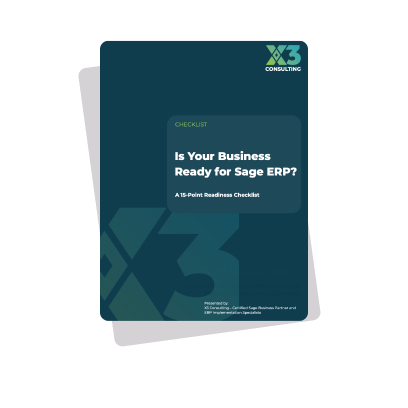
CHECKLIST
Find out if your business is ready for ERP adoption
The readiness checklist outlines the 15 most critical areas your business should assess before moving forward with an ERP implementation.
A smooth ERP implementation starts with solid foundations. Readiness reduces risks, improves adoption, and accelerates ROI. Download the checklist to get a clear view of where you are on your ERP journey.
Which Sage product is right for you?
Sage X3
– 50+ employees
– Turnover £20m+
Supply chain management software helps businesses to see and control the flow of goods and services across the entire company. Using software to automatically track movements and help plan resource requirements based on real-time data and insights ensures that everything is where you need it, when you need it.
Key industries
Distribution, Manufacturing, Process Manufacturing, Chemicals, Food & Beverage, Services
Sage Intacct
– 20+ employees
– Turnover £3m+
In wholesale distribution, you need to keep an eye on supply chain operations. Whether it’s optimising product inventory, streamlining purchasing, or managing multiple business locations, Sage Intacct gives you complete visibility into real-time performance, and automates complex processes.
Key industries
Service based industries including Professional Services, Finance, Distribution/Wholesale, Manufacturing
8 steps to delivering your ERP project
Following these 8 steps can help ensure that your ERP project is delivered on time, within budget, and meets your organisation’s goals.
Implementations objectives
Define the scope of the implementation by setting objectives and the problems the ERP system will solve.
Data migration
Determine how existing data will be transferred to the new system. Ensure data is accurate, consistent, and formatted correctly before migration.
Define the team
Assignment of a project manager to oversee the project including key stakeholders from different departments.
System customisation
Configure the ERP system according to the project requirements and any custom features or integrations needed. Perform thorough testing.
ERP discovery
Evaluation of the ERP options from Sage, and estimate project costs and risks along with the customisation required on the project.
Go live and support
Execute the go-live process, switching over to the new ERP system, Conduct comprehensive training sessions and support for all users.
Develop a plan
Establish a detailed budget, including software costs, hardware, training, and contingency funds.
Continuous improvement
Track system performance and user feedback. Regularly updates and optimise the ERP system as business needs evolve.

Experienced trusted Sage partners
X3 Consulting are experts in navigating complexities, optimising functionality, and delivering tailored solutions that align seamlessly with your business needs.
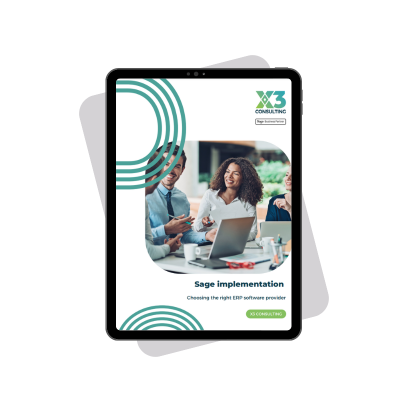
Implementation guide
Find out more information about Sage ERP implementation
When investing in the future, it is important to understand how ERP implementation will affect your business and what you need to prepare for.
Download the implementation guide to find out more.
How we deliver your project
X3 Consulting have a unique delivery plan that we collaborate with our customers on.
We conduct comprehensive business analysis and design a tailored solution, ensuring that the ERP system implementation aligns closely with your specific requirements and objectives.
Before starting the ERP implementation process, conduct a thorough analysis of the client’s business processes, goals, and challenges. This analysis helps identify areas for improvement and ensures that the ERP solution is tailored to the specific needs of the organization.
Ensure seamless integration of the ERP system with existing software applications and data sources within the organisation. Develop a comprehensive data migration plan to transfer relevant data from legacy systems to the new ERP platform while maintaining data integrity and accuracy.
Develop a customised ERP solution design based on the findings of the business analysis. This design should take into account the unique workflows, industry requirements, and future growth plans of the client.
Conduct thorough testing throughout the implementation process to identify and address any issues or discrepancies promptly. Continuously optimise the ERP system based on user feedback, performance metrics, and evolving business requirements.
Implement the ERP solution in phases rather than attempting a full-scale deployment all at once. This phased approach allows for better control, testing, and adjustment of the system while minimising disruptions to day-to-day operations.
Design the ERP solution with scalability and flexibility in mind to accommodate future growth and changes in the business environment. Implement modular components and configurable settings that allow for easy expansion and customization as the organisation evolves.
Implement a robust change management strategy to help employees adapt to the new ERP system effectively. This strategy should include communication plans, training sessions, and ongoing support to address any concerns and ensure user buy-in.
Provide ongoing support and maintenance services to ensure the long-term success of the ERP implementation. Offer regular system updates, troubleshooting assistance, and user training to address emerging needs and maximize the value of the ERP investment.
Talk to a specialist
Got questions about ERP implementation?
Drop us a line for a no obligation chat. Our specialist implementation team will be happy to answer any queries you may have.
